Some Animals Are More Equal…….

I finished George Orwell’s Animal Farm last night. Took me one sitting. It’s a thin book, the kind you could lend to a friend and never get back, and I kept telling myself it was just a story about some farm in England and a revolution that went wrong somewhere far away, a long time ago.

I’ve been telling myself that since morning. It isn’t working.

Quick recap if you haven’t read it. The animals throw out Mr. Jones, their drunk and cruel farmer. They paint seven rules on the barn wall, all about equality. The pigs are the smart ones, so naturally they end up doing the thinking for everyone. And then, slowly, nobody can say exactly when, the farm turns into something the animals don’t recognise anymore.

That’s it. That’s the book. So why couldn’t I sleep?

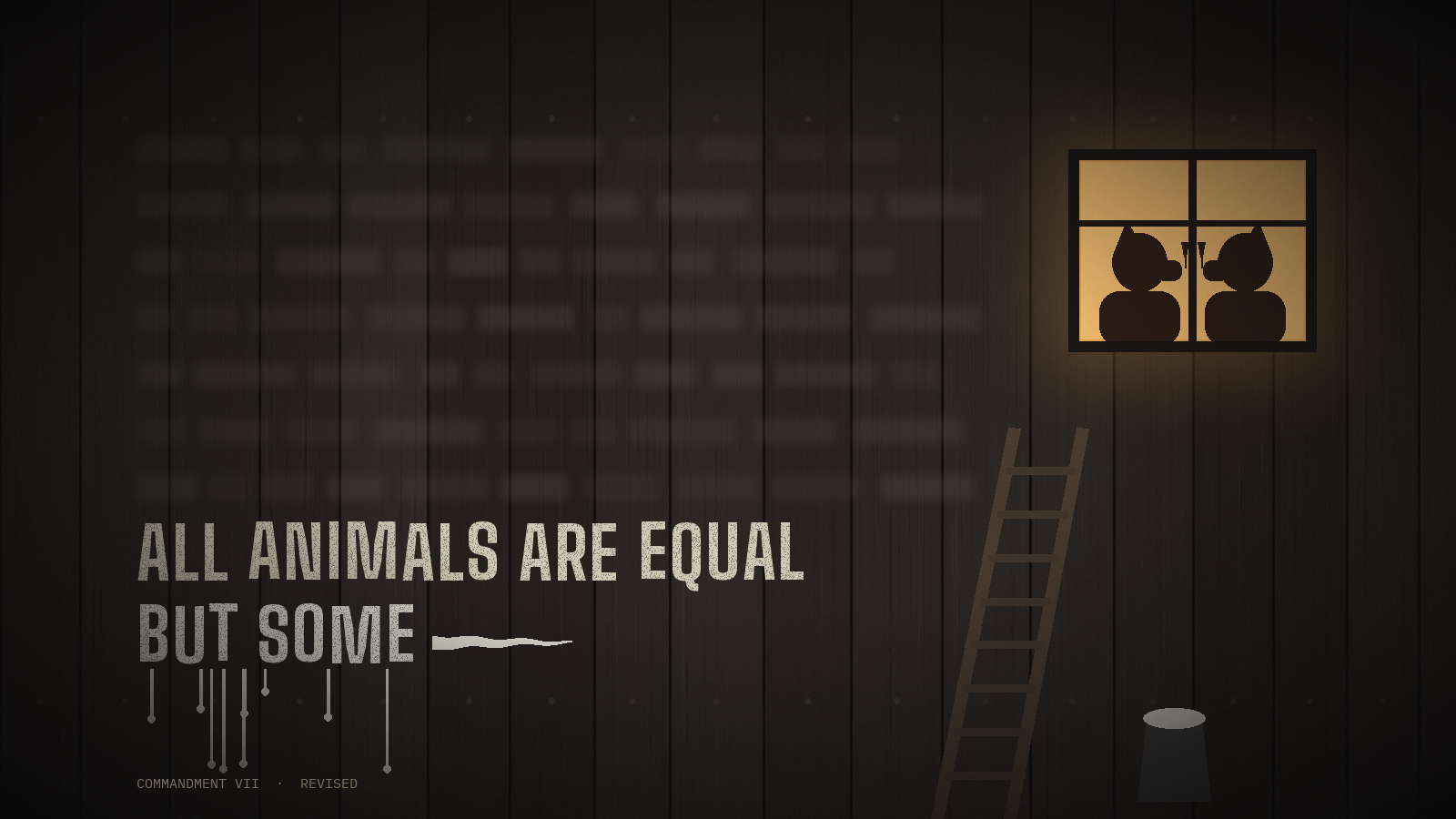
Maybe because of the rules on the wall. In the book they keep changing at night. A word gets added. A line goes missing. When the animals complain, they’re told their memory is weak. I thought about that while reading how chapters are quietly vanishing from our children’s textbooks. Whole centuries gone. Kings who ruled for generations, just… edited out. Even evolution was found to be surplus to requirements. A child who never reads the old version can’t ever say the wall used to look different.

Then there’s Squealer. The pig with the numbers. Every week he climbs up and announces that production is up and everyone’s better off, and nobody ever sees the actual ledger. I remember a jobs survey that came back with a very unhappy number and was mysteriously held back till the voting was done. And the headcount of the country, the one that’s supposed to happen every ten years like clockwork? Still waiting. Funny how hard it is to feed animals you haven’t counted.

Snowball made me laugh, honestly. He’s chased off the farm in the first half of the book, and after that literally everything is his fault. Windmill falls, Snowball did it. Harvest fails, Snowball. Our Snowball left the farm before most of us were born. The man’s been gone for decades and he’s still the busiest employee in the country.

And the windmill. Orwell’s animals nearly die building it, and nobody asks what it’s even for, because look how big it is. We have the tallest statue in the world now. A new building for the pigs to argue in, with a golden sceptre carried in by priests. A bullet train that has been arriving for years. Look up, the animals are told. Don’t look at your feet.

Speaking of animals who actually do the work. I kept thinking of that winter, and the summer after it, when farmers sat outside the capital for a whole year over three laws nobody had really asked them about. Some of them never went home. They were called terrible names on television. Then one fine morning the laws were withdrawn like nothing happened. The names were not withdrawn.
You know the sheep. Four legs good, two legs bad. Anytime somebody in the yard starts a question, the sheep start bleating until you can’t hear it anymore. I don’t think Orwell could have imagined WhatsApp. Our sheep wake up earlier than the roosters now. Their phrase has changed a bit. Ask a question and you’re anti-something, and would you please go live on the neighbouring farm.

The dogs are the part that stayed with me. Napoleon takes some puppies away and raises them in private, and when they’re grown they don’t chase foxes. They guard the farmhouse from the other animals. Ours are very busy dogs. Though I’ve noticed they mostly patrol one side of the yard. And if an animal from that side hops the fence and joins the farmhouse? The dogs just… lose interest. People have started calling it a washing machine. I think of it as a door that only swings one way.

There was also, for a while, a system where sacks of grain could be left at the farmhouse door with no name on them. Totally anonymous. The highest court finally said no, you can’t do that. By then most of the sacks had already been delivered. To guess which door, you don’t need Orwell.

Moses the raven I’ll be careful with, because faith is precious and I mean that. In the book he flies around talking about Sugarcandy Mountain, a paradise in the clouds where every sacrifice gets repaid. The pigs don’t believe him, but they keep him around. Useful bird. A farm that promises heaven later can get away with promising a lot less right now.

And Boxer. God, Boxer. The big loyal horse. “I will work harder.” “Napoleon is always right.” The best creature in the whole book, and the one it’s cruellest to. I thought of the workers who, one spring, were given four hours before the entire country shut its gates, and who walked home. Hundreds of kilometres, on highways, kids on their shoulders. Some of them still say he must have had his reasons. That’s Boxer. He never stops believing, and that’s exactly what breaks your heart.

Everyone knows the ending. The animals press their faces to the farmhouse window and see the pigs having dinner with the humans they once overthrew, and they can’t tell which face is which.

I look through windows too, these days. I see animals who used to shout at each other across the yard now sitting at the same table, same colours, same glasses raised. And the pigs who ran the farm before? When it was their turn, they did plenty of the same things. Nobody at that table has clean hooves.

So no, I can’t tell which face is which either. I don’t think Orwell could. I think that was the whole point.

I’m not naming anyone. I’m just someone who read a small book on a weeknight and hasn’t been able to put it down since.

All animals are equal. But some animals are more equal than others.
Posted in Country, India, Uncategorized | Tagged , , , , | Leave a comment

Agile Governance

A G I L I T Y

Agility is vital in the realm of business and management, showcasing an organization’s prowess in swiftly and effectively responding to evolving circumstances. By embracing flexibility, enhancing capabilities, fostering adaptability, aligning strategies, and pursuing continuous evolution, businesses can fortify themselves against the relentless tide of change. These qualities serve as the litmus test for the extent to which a business remains competitive and resilient in today’s rapidly transforming environment.

G O V E R N A N C E

Business or corporate governance is the quintessential foundation upon which successful companies are built. It encompasses a robust system of rules, practices, processes, and structures that guide and govern the direction, control, and operations of a company. The primary purpose of business governance is to ensure unwavering alignment between the company’s actions, decisions, and its overarching objectives, all while upholding the highest ethical and legal standards.

To achieve effective business governance, it is imperative to establish crystal-clear roles and responsibilities, adopt transparent decision-making processes, and implement comprehensive mechanisms for accountability and meticulous oversight. This holistic approach creates a strong foundation for the company, fostering a culture of innovation, continuous learning, and proactive decision-making. By embracing the tenets of sound business governance, companies can chart a course towards long-term success and sustainable growth.

D I L E M M A

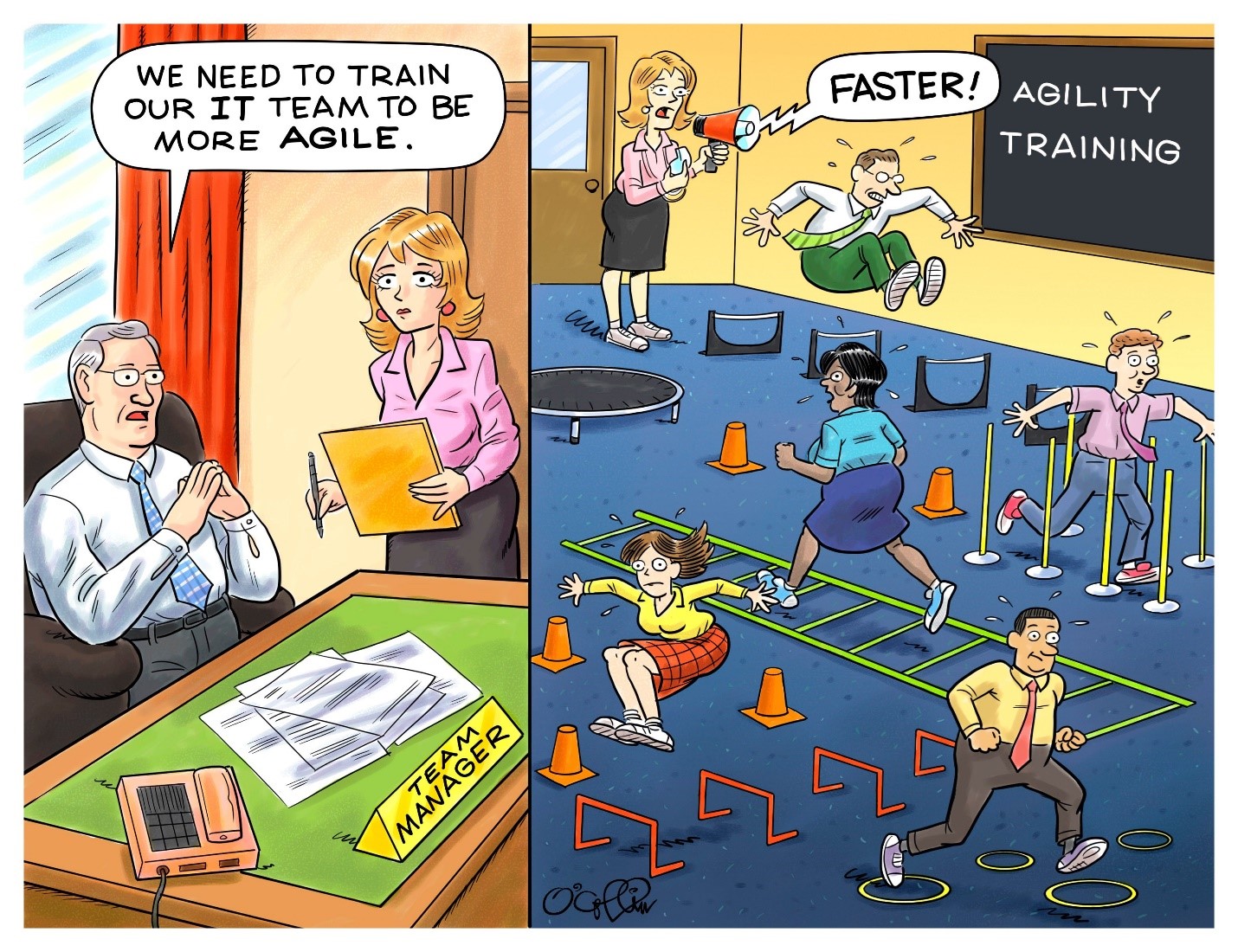
In the ever-changing corporate jungle, leaders find themselves doing the tango between the need for governance and the desire for agility. Picture a CEO cha-cha-ing with a rulebook while trying to keep up with the fast-paced twists and turns of the business world. It’s like watching a hilarious dance battle between a strict ballroom instructor and a wild, free-spirited improviser. Will they ever find the perfect balance? Well only rare resilient, patient and mature one will “perhaps” be able to do it.

More often than not, obsessive governance ends up in a situation as depicted in following cartoon

Challenges Faced by Contemporary CEOs in the Current Dynamic Business Environment

  1. Rapid Technological Advancements
  2. Evolving Customer Expectations
  3. Agile Competition
  4. Regulatory Landscape
  5. Globalization

For assuring of success, let’s explore some winning strategies for effective and practical business governance that can pave the way for enviable accomplishments.

Embracing Agility and Flexibility: In today’s fast-paced world, traditional governance structures can feel constricting, stifling innovation and growth. It’s time to break free and embrace the power of agile governance models that ignite passion and fuel success. These dynamic approaches enable rapid decision-making, empowering businesses to swiftly adapt and thrive amidst ever-changing landscapes. It’s a call to arms for those who dare to challenge the status quo, to unlock limitless possibilities, and to forge a future defined by passion and untamed potential.

Embracing Data-Driven Decision-Making: Harness the power of data analytics to drive informed and strategic decision-making. By leveraging real-time insights, businesses can proactively respond to evolving trends and make confident choices that propel them towards success.

Embrace the Uncertain: In a world of constant flux, risks lurk in every corner. Don’t shy away from the chaos, but rather relish in it! Engage in thrilling risk assessments that unveil potential vulnerabilities, paving the way for the exhilarating implementation of innovative mitigation strategies. Prepare to conquer the unknown and stand tall amidst the ever-evolving challenges!

Powerful Stakeholder Engagement: Unleash the true potential of your organization by passionately engaging stakeholders at every level. Harness the invaluable insights and diverse perspectives offered by your employees, investors, and cherished customers. Let their voices guide and inspire your governance decisions, paving the way for extraordinary success and boundless growth. Stand at the forefront of stakeholder engagement and propel your organization towards a future brimming with unparalleled achievements.

Embracing the Power of Ethical and Social Responsibility:
We find ourselves in extraordinary and transformative times, where the importance of embracing ethical practices and showing unwavering social responsibility becomes even more evident. It is not only crucial to protect the reputation of our brand, but also to foster deep trust among all our stakeholders. Navigating this path with empathy and compassion will ensure that our actions inspire positive change.

Embrace the Power of Scenario Planning: Harness the potential of “what-if” scenarios to proactively anticipate and navigate through various potential futures. By engaging in this strategic exercise, businesses can fortify their preparedness, craft adaptive strategies, and confidently tackle uncertainties head-on.

Unleash the Power of Continuous Learning and Innovation: Embark on an exhilarating journey of relentless growth and boundless creativity. Ignite the flames of curiosity and ignite a fervor for constant improvement. Nurture a dynamic culture that embraces change, empowering each individual to evolve, learn, and transform.

C O N C L U S I O N

In an ever-changing and demanding business environment, effective governance becomes the cornerstone of success. It empowers organizations to navigate challenges and seize opportunities with unwavering determination. By embracing agility, harnessing the power of data-driven decision-making, and proactively managing risks, businesses can not only withstand uncertainty but propel themselves to new heights. Ultimately, it is those companies armed with a robust and adaptable governance framework that will boldly emerge as trailblazers in the dynamic landscape of tomorrow.

Posted in Business, Governance, Intrepreneurship, Management, Performance, Uncategorized | Tagged , , , , , , , , | Leave a comment

Interdependent Independence

Photo by Magda Ehlers on Pexels.com

As a country India is deemed to be standing at the cusp of greatness.

Cusp is always a dangerous territory.

It is a slippery slope which henceforth demand only right moves. One wrong move and an abyss stare wide open at your face.

In 75th year of independence of India, the mantra which is being propagated is of Self Dependency (Atam Nirbhar).

Self-dependency is a tricky phenomenon.

Logically self-dependency does not exist.

Self-Dependency is, in effect an intricate web of interdependencies.

So the independence which is so romantically desired is in effect a well-oiled environment of interdependency. This is quite a Paradox.

But this phenomenon is visible in every phase of life, profession and pursuit.

A very common and overused phrase is “A Chain is as strong as its weakest link”. Howsoever overused it is, it remains the most potent management principals of all times.

To be successful in any pursuit or endeavor, a strong interdependency needs to be created at every single bit of process. Only when these interdependencies work with a clockwork precision, success in the pursuit or endeavor will be achieved.

Following is a very elementary cheat sheet for creating such interdependency in any process

  1. Stock Taking of the problem in hand
  2. Introspection – GAP analysis of end to end process
  3. Create Signposts within the processes, bring visibility
  4. Create vision post for each subprocess, simple enough to reflect what lies ahead at transactional level
  5. Create interdependencies – Create it like a unifying force
  6. For each subprocess Interdependencies to be defined in form of vendor-customer relationship
  7. Trigger the process

From sidelines, as an able-bodied manager, all one has to do is to keep a watch on these interdependencies falling apart (which will happen).

When it happens, communication need to be triggered

To guarantee success, the communication needs to be in form of either appreciation (?) or productive criticism.

I have applied above in every walk of life and profession and have been immensely successful (In my opinion)

Productive Criticism is the key, will write about it in detail in further posts

Criticism Divides (breaks), Productive Criticism unites (motivates)

Posted in Business, Country, Economy, Finance, Governance, Independence, India, Intrepreneurship, Management, Uncategorized | Tagged , , , , , , , | Leave a comment

Sunday Musings – 22nd August 2021

The Art of Swearing

Deep Breath, Belch, Fart, Yawn…..

The one thing which above all commonly bring is relief…..

But one which brings utmost relief is perhaps swearing…..

Swearing with profanity, the use of Cuss words…..

Cuss words carry an aura around them. Interestingly this aura has a variation which is directly proportionate to the language in this cuss words are used…..

They sound very sophisticated in English, overbearing and emphatic in Punjabi, demeaning in Hindi and ugly in Kannada…..

And so on…..

I am not advocating any use of profane language here but am trying to understand the need and the efficacy of same…..

Profanity, believe it or not, if used sensibly and if obscenity is avoided, is super-efficient…..

Just imagine the brevity with which it conveys messages which are, at times so complicated to convey…..

Next time you hear something profane, just try to assimilate the immense depth of thoughts it is trying to convey…..

Or else try to look it from perspective of a compensatory offence…..

Whilst the receiver might have been part of some damaging and detrimental accomplishment, the other party might be just exercising a compensatory offence…..

You may read and absorb the above with a pinch of salt but I am pretty serious about what I am saying because…..

Researchers at Marist College in New York say a big vocabulary of curse words is a sign of higher rhetorical skill, and those that can name the most swear words in one minute tend to have a greater overall vocabulary…..

These findings challenge the stereotype that people curse because they can’t find more intelligent things to say…..

So feel free…..

Posted in Business, Economy, Finance, Governance, Independence, India, Intrepreneurship, Management, Modi, Politics, Uncategorized | Tagged , , , , , , , , , | Leave a comment

Sunday Musings – 15th Aug 2021

Wisdom

First of all a very happy 75th Independence day to all…..

The momentous day brings about an opportunity wherein we can just pause a little and do a little introspection…..

That’s perhaps what the holiday is about rather than the wearing the insane Nationalism up your sleeve and then flaunting it unabashedly…..

So what I am contemplating is to go a little unorthodox at this point of time…..

This heretical approach pushed me to a belief about the most important virtue of a wise person – Wisdom…..

Is wisdom finite, is it progressive, is it relative, is it a capacity…..

The answers to above are not straight forward but they are not complex either. It is actually a perspective and that makes it the most interesting thing to understand…..

A very simple bookish definition of wisdom is : “Knowledge of what is true or right coupled with just judgement as to action”…..

But this definition makes wisdom a very constricted trait, a very finite something…..

Whereas wisdom is exactly opposite of it…..

I will always put wisdom in juxtaposition with spirituality and that opens up immeasurable and unbounded possibilities…..

It is not the intellectual knowledge which defines wisdom, wisdom actually stems out of consciousness…..

Wisdom is actually a divine perception which is possible through spiritual awakening…..

Emotions cause anxiety, Spirituality helps you to overcome emotions which in turn controls anxiety and this it fuels up wisdom…..

Wisdom is an energy which gets destroyed when we ruminate and brood over things which are beyond our control. Spirituality kills that brooding…..

Spirituality brings mindfulness. Mindfulness helps in resisting uselessness. Productivity is a direct result of such resistance and being a man of wisdom actually means being a productive man…..

Spirituality fuels positive convictions, selflessness and respectfulness which in turn fuels ethics and morals. An ethically and morally rich life brings peace and prosperity…..

Being wise and being full of wisdom builds up a character and sense of righteousness and once it is built up, life becomes an answer of “Why to Live?” rather than “How to Live?”…..

Spirituality is nothing but an attitude of quality with which the daily chores of an ordinary life are performed…..

Interestingly that is just about the definition of wisdom also…..

Posted in Business, Country, Finance, Governance, Independence, India, Intrepreneurship, Management, Performance, Uncategorized | Tagged , , , , , , , , , , , | Leave a comment

Sunday Musings – 8th August 2021

Narratives

“Good Morning Mr. Mandela” is the name of the Book I have started to read couple of days back…..

I have a habit of doing a small research about the book before I start reading it…..

It was a little bit of surprise for me to know that the Author Zelda La Grange is a “White” woman…..

Why ?????

Because Mr. Mandela was an Anti Apartheid champion and so it comes naturally to our mind that he will be an anti white person also…..

So what has a white woman to do with Mr. Mandela…..

Much of it comes from the narratives which are built about people, issues and events…..

Few glaring examples of perceptions built because of narratives are below. Few of these perceptions have changed over a period of time. Much of these changes in perception have come from building alternative narratives…..

A. India is a land of Snake Charmers…..

B. Religious Text of other religions (than practised by you) advocate supremacy over other religions…..

C. Being Positive always keeps you happy…..

D. Being Educated means being learned…..

and so on…..

Our lives revolve around the narratives which are built around us…..

Over a period of time, these narratives become beliefs and over a longer period of time, perhaps a part of folklore…..

However one needs to be careful about the narrative he/she choses to believe…..

More so in the age of social media…..

Because narratives can manipulate the thinking process…..

Which can then influence choices…..

Narratives which are built to influence choices are, more often than not, fake…..

So fake narratives lead to fake beliefs and fake beliefs then lead to wrong choices…..

So it is important to have a 360 degrees view of a narrative before going on to place your much valued belief upon it…..

Before you place your belief, classify the narrative in front of you in two broad categories…..

Gossip or Fact…..

The simplest test is that whilst gossip will have alternative versions, fact will have singular version…..

So then the choice becomes much easier…..

Let not fake narratives manipulate your thinking process…..

Posted in Business, Country, Economy, Governance, Independence, India, Intrepreneurship, Management, Performance, Uncategorized | Tagged , , , , , , , , , | Leave a comment

Sunday Musings – 1st August 2021

The Power of Simplicity

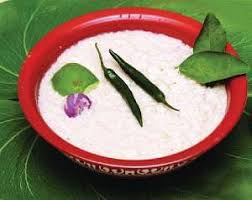
Mastechef Australia Finale and a finalist with roots from Indian Subcontinent serves a staple dish called “Panta Bhat” to the judges…..

Panta Bhat is a dish which has origins in Eastern Part of India…..

The legends about the diet is that it came out of misery…..

In a hot and arid climate where neither natural or artificial refrigeration or preservation was available, people who cannot afford to throw leftover rice, will leave the same overnight in water. The rice in water fermented overnight give a sour tangy taste in the morning and eventually became a dish to savour with…..

Over a period of time, analysis about nutritional value of the dish came into play and a niche was developed around the staple dish…..

The masterchef incident created a furore…..

The elite called it an insult to standard of the program…..

The lesser mortals went ecstatic over the elevated pitch their run of the mill stuff got…..

Ecstasy and Euphoria eventually won over the perceived insult and the incident went on to receive a cult status…..

Today the video about the dish which has origins in misery are going viral…..

Elites in sophisticated urban colonies of India are making these videos viral as they cook the dish and serve it with pride on their Breakfast Tables…..

Simplicity had an elegant win over Sophistication…..

It always does have that elgant winning edge over sophistication…..

Sophistication is plastic, it is animated. Simplcity is deep, it is profound…..

Sophistication is temporary, Simplicity is lasting…..

Sophistication can be bought, Simplicity comes natural…..

Simplicity is necessary, Sophistication is dispensable…..

Adopt Simplicity, it pays in the long run…..

Posted in Business, Country, Finance, Governance, Independence, India, Intrepreneurship, Management, Performance, Uncategorized | Tagged , , , , , , | Leave a comment

Sunday Musings – 25th July 2021

Valeur De Deuxième

Mirabai Chanu is Ecstatic afer winning a silver medal for India…..

The picture says a thousand words…..

But wait, a silver medal is second position on the podium, isn’t it ?????

So since when we started celebrating being #2 ?????

All along in life, we are being taught to be the #1 in whatever we do…..

However, being #2 is more important than being #1…..

The beauty lies in the fact that someone is #1 just beacuse a #2 exists…..

If #2 ceases to exist, the romance of being #1 will just extinguish…..

#2 shifts the burden of expectations and brings about a balance in whole scheme of things…..

#2 is the only motivation in the entire cosmos for the #1…..

#2 ensures that no matter what happens the rigor in the entire arrangement remains alive…..

Absence of #2 in art makes it boring, the connoisseur of the art will have to be content with mediocre performances if #2 does not exist…..

#2 in a corporate world will always be more important than anything else because he/she holds the key to the future…..

Absence of #2 in poilitics will turn the chieftain into a potentate and finally into a tyrant…..

India badly needs a #2 on its political horizon now, very badly…..

Let us all strive to be the #2 and a pretty effecive and efficient #2…..

The #1 will always badly need that elusive, effective and efficient # 2…..

Posted in Business, Governance, Independence, Intrepreneurship, Management, Performance, Uncategorized | Tagged , , , , , , , , , , | Leave a comment

Sunday Musings – 19th July 2021

Skill Vs. Attitude

The most famous image of recent times is reproduced below…..

A mighty alpha human, bending down and eating grass after scaling an imposing height, perhaps one of the greatest in the sporting history of Humankind…..

The image can be interpreted as a superhuman exhibiting humility after achieving the almost impossible…..

But as Novak chose to put it…..

“As a kid I was dreaming of winning Wimbledon, so, like every child, you dream of doing something crazy when you actually achieve it — if you achieve it — and that was one of the things.”

In saying so, Novak demonstrated the most amazing trait of all living beings…….

….. A T T I T U D E …..

No I am not here to discuss that Attittude = 100% according to alphabets bullshit…..

We the humans are programmed to believe that the pre-requisite to success in life is skill…..

Sadly, in most of the cases, it is not seen as a pre-requisite but as the ultimate key and trait to achieve success…..

Cambridge dictionery defines Skill as “Ability to do things well, especially because you have practised it.”

And trust me that’s all we can say about Skill…..

Skill brings you dexterity, proficiency, knowledge, technical expertise etc…..

But that’s all about it…..

The above can guarantee you ease whilst your execute, but can it guarantee success?????

Well that’s a million dollar question…..

Attitude is defined as a “Position (?) assummed for a specifice purpose”.

The synonyms for Atttiude are – Approach, Belief, Point of View, Stance…..

So what is more romantic? Well in my opinion it is certainly attitude…..

Whilst skill leads to curiosity and anxiety, attitude leads to amusement and joy…..

How many inventions in the world we can attribute to skill?????

Probably nothing…..

Inventions do not stem out of craftsmanship that skill imparts but are largely result of the cunninness which attitude brings to you…..

So what do you need in life to be successful, Skill or attitude?????

Well in my opinion, the right balance of both…..

Mere skill will make you part of crowd, mere attitude will make you an overbearing, imposing, good for nothing brat…..

A right mix and a right team of both the traits is needed to succeed…..

Who what should be the percentage? 50-50?????

Or something else…..

Well to explain that i will use the anlogy of Left and Right hand…..

Both hands are needed for perfect execution…..

Some use right hand more and some use left hand more and a few rare ones are ambidextorous…..

Of course there are very few sepcially abled souls who make it good for their life on one or no limb also but those are very rare and can be taken only as an exception and not as an expample…..

I hope I am able to explain it clearly…..

Coming back to where we started, in 2021 Wimbledon final, Berrettini had better skills than Djokovic, he certainly had…..

But at the end, it was Djokovic’s attitude which made him the invincible champion he is…..

But Djokovic could not have done it with no skill and only attitude…..

He could have never…..

Posted in Business, India, Intrepreneurship, Management, Performance, Uncategorized | Tagged , , , , , , , , , , , , , | Leave a comment

Sunday Musings – 11th July 2021

How Trains Inspire me…..

The image shared is taken by me during a lazy Sunday walk…..

We have shifted into our new beautiful home, our dream home about a year back…..

There is a railway track which runs about 3 kms away from our house…..

A rumbling sound of train passing can be heard in our house at regular intervals. The sound is not disturbing at all. Instead it seems like music to ears and I feel refreshed whenever I hear those sounds…..

Trains have always fascinated me…..

My favorite pastime is to walk down those rails, with my buddy, Bentley, our adorable Labrador walking besides me…..

I enjoy the walk like nothing else. Bentley although gets disturbed when a train passes by…..

My Kids find this obsession of trains quite bewildering and at times quite childish as well…..

I sometimes gets admonished by my kids on this obsession also. My proposals to travel by train rather than by flights gets shot down instantaneously…..

I always, however, tell them that before I meet my parents in heavens, I will surely cover the entire length and breadth of country in a train journey…..

My obsession with trains is not childish…..

As a matter of fact, everytime I see a train passing by, I derive few important management lessons out of it. I will share few of those below…..

Discipline: Trains follow immaculate discipline. The routine, the process and the procedure followed by train, as a train, is mind blowing. The almost 2.5 kilometers of thing follow a straight line approach to make the thing happen as it is supposed to happen…..

Rhythm: A subset of discipline, just watch a train passing by and observe the rhythm it follows. Tell me if it does not fascinates you…..

Respect: Think about waiting at a signal for a train to pass by. Whilst you look at your watch, waiting for that stupid rod of steel to get lifted, it breezes past you, like a king in its full glory…..

Try practicing the same discipline and same rhythm in your life and your profession and tell me will you not be commanding that respect…..

Posted in Uncategorized | Tagged , , , , , , , , , | Leave a comment

The Illusion of the AI Back-Office

We have a habit of comforting ourselves with stories about our own inevitability. For years, the story has been that India is the world’s engine room, the indispensable back-office that keeps the digital wheels turning because we have an endless supply of young, low-cost talent. We look at the sheer scale of our engineering colleges and tell ourselves that even if the world changes, they will always need us to run the systems. But lately, that story feels like it is being edited while we sleep. The recent shift in the US political landscape, with a Democrat Blue Wave in Congress, is a reminder that the world is not waiting for us to catch up. While Washington debates tariffs and domestic AI infrastructure, we are busy building a very different kind of structure at home. We are building a welfare vortex that is quietly starving our future to pay for today.

The faded edge of cheap talent

The common wisdom is that India’s edge is its low-cost human capital. If you look at the numbers on a spreadsheet, the logic seems to hold. An entry-level engineer in Bengaluru is still significantly cheaper than one in San Francisco or London. But we have to ask ourselves if that edge still exists in any meaningful way. I do not think so. We have destroyed that advantage by moving at a breakneck speed towards becoming a welfare state.

When a country decides to prioritise redistribution over productivity before it has actually built its industrial base, the "low-cost" label becomes a myth. The cost of a worker isn't just their salary. It is the cost of the environment they live in, the power they consume, and the taxes required to fund a massive state apparatus. By focusing so heavily on welfare, we are not just helping the vulnerable; we are changing the fundamental math of our competitiveness. If the cost of doing business is inflated by the need to fund a sprawling safety net, our human capital is no longer "low-cost" in the eyes of global investors. It is just capital that comes with too many strings attached.

Caught in the subsidy vortex

This brings us to what I call the vortex. It is a cycle that looks like progress but often leads nowhere. You see it every time a state government holds a massive investor summit. There are grand announcements, flashing lights, and thousands of Memorandums of Understanding (MoUs) signed with great ceremony. But the reality is sobering. Only 20 per cent or less of such MoUs ever actually fructify. The rest are just paper and ink, meant for headlines rather than factories.

When a project does actually get off the ground, the business enters the vortex. The state government offers massive subsidies and incentives to invite the capital in. However, to pay for the very welfare schemes that win elections, the state has to extract value elsewhere. The business starts to absorb the cost of these schemes in the form of high wages, compliance costs, and indirect taxes. When the business starts to struggle under those costs, the government offers another tranche of subsidies and incentives to keep them there. It is a self-defeating loop. We are using subsidies to fix the problems created by the costs of our own welfare state. It is a merry-go-round that keeps us spinning in place while the rest of the world moves forward.

Diverting the future to pay for today

There are two dimensions to our current stagnation. First, India has failed to build the know-how and research to stay ahead in the race. Second, the money which should have been deployed in this endeavour is being sucked away by welfare schemes. In the global AI race, we are essentially playing on someone else's pitch. We have spent decades perfecting process optimization for foreign platforms, but we have failed to create foundational intellectual property. We are the world’s best mechanics, but we don't know how to design the engine.

While the US and China pour billions into foundational R&D, our focus is elsewhere. We spend less than 0.7 per cent of our GDP on research, and a huge portion of our national budget is tied up in subsidies. We are choosing consumption over creation. If AI capital stays in the US to build domestic infrastructure, as some analysts suggest following the midterm elections, India loses its window. We cannot be an "AI back-office" if the back-office itself is automated by tools we didn't build and don't own. Without foundational IP, we are just waiting for the day our current roles become obsolete.

The sugar-coated application pill

There is a popular argument that India doesn't need to build its own Large Language Models (LLMs) because we can "win at the application layer." To me, this is a sugar-coated diversionary pill. It is a way of making our indifference to foundational research sound like a strategy. We are being told to look at the apps and ignore the fact that the underlying technology belongs to someone else.

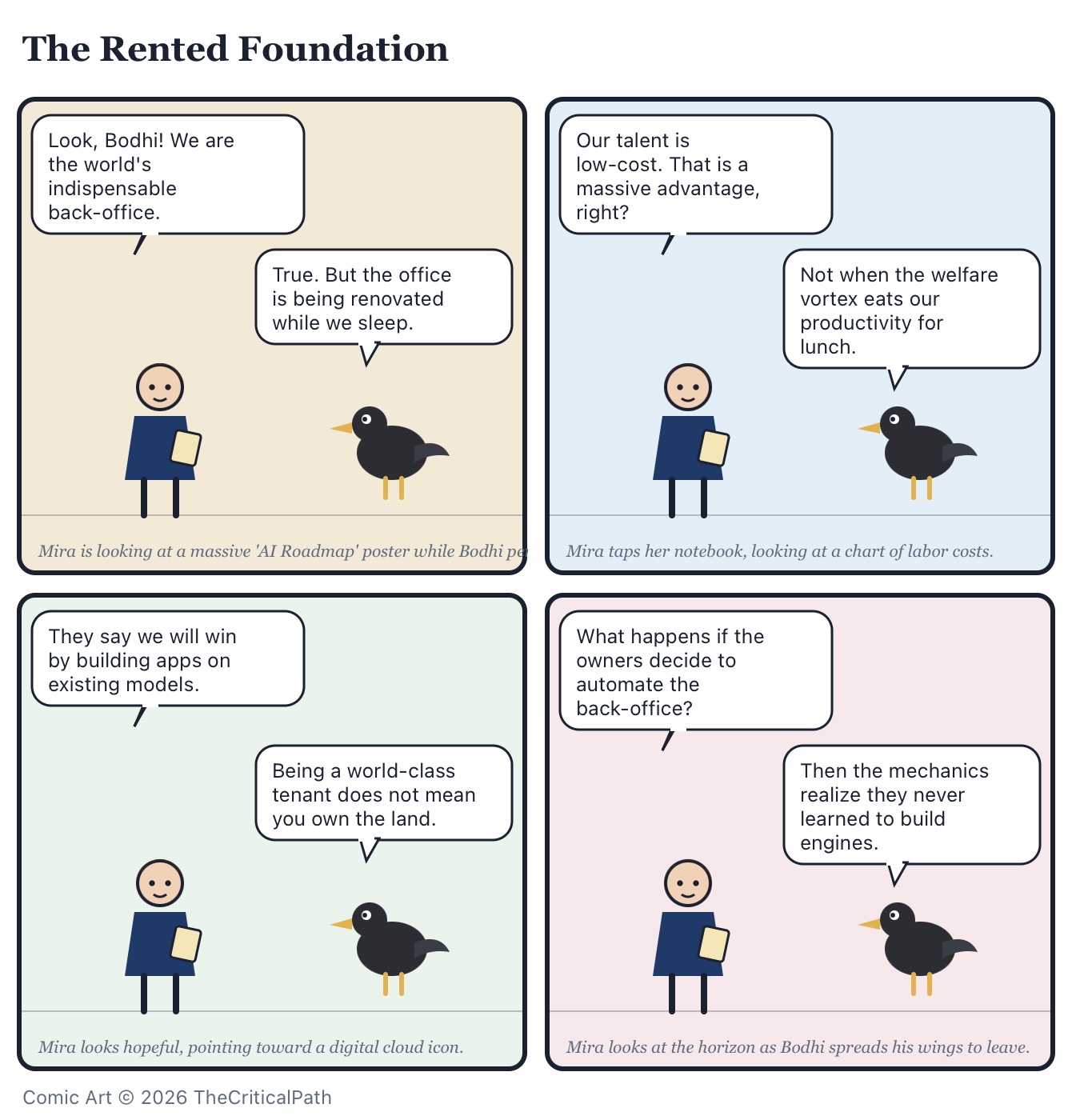
This indifference is dangerous. It is much like the "Viksit Bharat 2047" bogey, a promise of a developed state decades away that serves to distract us from the structural failures of the present. If we are content to just build applications on top of American or Chinese models, we are choosing to be rule-takers. We are building our digital future on rented land. A country that does not own its foundational technology cannot claim to be a global leader. It is just a very efficient tenant.

A comic strip where a person and a bird debate the risks of building on rented technology.
Comic Art © 2026 TheCriticalPath

The danger of trusting national champions

Some argue that the only way out is the "National Champion" model, where the government puts its weight behind a few massive private conglomerates to lead the way. The logic is that the state lacks the teeth and the vision to push through real reforms, so we must rely on these giants to do the heavy lifting. But we have to ask if this is sane.

If these national champions are truly "National," that has to stand the test of time. Will they be generous like the Tatas were in the past? The Tatas built the Indian Institute of Science, Air India, and the Indian Postal System and then handed them over to the government for the welfare of the general public. Do the structures we are creating today have that kind of vision? I do not think so.

Handing over a strategic and visionary roadmap to private institutions is a massive gamble. We should remember what happened when the East India Company gained control of such strategic roadmaps. When private interest and national strategy become indistinguishable, the public good is rarely the priority. If our national champions are only interested in capturing the "vortex" for themselves, they are not champions of the country; they are just champions of their own balance sheets.

We are at a crossroads. We can continue to fund a welfare vortex and hope that our old stories about low-cost talent keep us safe, or we can start the hard work of building foundational know-how. If we keep choosing the sugar-coated pill, we shouldn't be surprised when we wake up to find the wall has been repainted, and we no longer recognise the farm.

Sources

Posted in Uncategorized | Tagged , , | Leave a comment

The Subsidised Superpower: Why Megaprojects Cannot Fix Our Dejected Youth

We hear a great deal these days about our diplomatic weight and our place at the high table of global politics. Everywhere you look, commentators are celebrating shiny new infrastructure, high-tech assembly plants, and our rising status as an indispensable middle power. But what good is bragging about capturing high-tech assembly and building grand projects when our youth remain dejected and unemployed? We are celebrating a diplomatic moment on the international stage while ignoring a deep, painful friction at home. Geopolitical weight is completely useless without mass job creation, yet we seem content to point at concrete and glass while a generation of educated young people loses hope.

The Illusion of the Middle Power Moment

There is a growing narrative that India has reached a new middle power status, capable of swinging global trade and security simply by virtue of its size and strategic position. Foreign leaders line up for summits, and international commentary regularly praises our multi-alignment. Yet we need to look closer at what this diplomatic attention actually represents.

Getting invited to platforms like the Quad is far more about a western tactical ploy to keep China on its toes than it is a sign of deep strategic weight. The United States cannot contain China without India, so we receive the invitations, the summits, and the photo opportunities. But being useful in someone else's regional calculus is not the same as building self-sustaining power.

The same logic applies to the flurry of trade agreements and headlines about bilateral deals. They remind me of the investment meets organised by Indian state governments over the years. Hundreds of Memorandums of Understanding are signed with great fanfare, photos are taken, and huge sums are announced. Yet when you check the actual record, only a negligible percentage of those MoUs ever convert into real investment or actual business flow.

Consider the proud announcements about capturing high-tech manufacturing, such as the assembly of iPhones and other electronics. Is it manufacturing, or is it merely assembly? When you look at the net exports out of those headline figures, the reality becomes far more modest once you subtract the cost of importing foreign components. Bringing in high-value parts from overseas to assemble them locally under tax subsidies does not mean we have built a self-sustaining industrial base. It means we are performing the final, low-margin step in a global supply chain while taking credit for the entire product.

Poverty Subsidised, Not Removed

To justify this optimism, analysts often argue that India is finally leaving its long history of poverty behind. But that argument is far too feeble to stand up to scrutiny. Poverty in India has not been removed; it has simply been subsidised.

Today, the country is running on a vast system of state freebies and welfare handouts. When a state spends its energy distributing basic provisions rather than building an economy that generates dignified, well-paying jobs, it has not solved the underlying crisis. It has merely made economic distress manageable enough to prevent immediate breakdown.

Handing out monthly allowances and basic grain keeps people afloat, but it does not represent economic progress. By substituting welfare schemes for broad-based industrial growth, we are disguising the true scale of underdevelopment. A nation cannot subsidise its way into becoming a genuine superpower.

The Forgotten Lessons of How Asia Works

Taking a leaf out of How Asia Works by Joe Studwell, the successful Asian economies of the past half-century were not built on clever hand-outs or surface-level assembly targets. They were built on the strength of two generations of blood, sweat, and hard effort. Real industrial capability requires long-term commitment, structural reform, and relentless discipline from both citizens and the state.

By turning India into a subsidised welfare state, how do we expect to build on anything when people are not willing to put in efforts, have become lazy, and are not concerned about anything since they are being taken care of? When a society relies indefinitely on basic relief without creating productive opportunities, it undermines the human foundation needed for true development. That is a harsh reality of today’s India, and no amount of optimistic speechmaking can hide it.

The Great Domestic Paradox

This brings us directly to the central paradox of our current development model. On one side, we have captured high-tech assembly lines, built massive infrastructure projects, and project a disciplined, modern image to the world. On the other side, millions of our youth remain dejected, unemployed, and deeply disillusioned.

How do we reconcile these two completely opposite realities?

We are told by official sources that employment is stable and the economy is thriving. But the data published by the current regime cannot be trusted to reflect what is actually happening on the ground. Anyone who speaks to young jobseekers or watches thousands of university graduates apply for basic manual government posts knows that the statistics do not match reality.

We are witnessing a persistent crisis of youth unemployment. Shiny airports, expressways, and high-profile assembly plants create impressive pictures for global audiences, but they do not absorb the millions of young people entering the workforce every single year. A bullet train or a massive new infrastructure corridor cannot hide the fact that the average graduate has nowhere to turn.

A Compromised Education System

The fundamental reason megaprojects will never solve this crisis is that they cannot replace human capital. And our human capital is in deep trouble because our education system is thoroughly compromised.

We have expanded higher education institutions in number, but degraded them in quality. Millions of students pass through colleges and universities every year, earning degrees that offer no practical skills for modern industry. They emerge into the job market with high expectations, only to discover that their education has left them completely unfit for modern industrial or technical work.

This is where the grand economic plans break down. You can offer tax incentives to foreign firms and build high-tech factories, but if your domestic education system produces graduates who lack basic technical skills and analytical grounding, those factories will remain isolated islands. They will import components, use minimal local skilled labour, and export the profits, leaving the broader population entirely behind.

We can build the largest projects in the world and take our bows on the international stage, but a nation that subsidises its poor while leaving its educated youth dejected is building on sand. Megaprojects will never replace human capital.

Sources

Posted in Country, Economy, Governance, India, Modi, PM, Politics, Prime Minister, Uncategorized | Tagged , , , , , , , , | Leave a comment