
We have a habit of comforting ourselves with stories about our own inevitability. For years, the story has been that India is the world’s engine room, the indispensable back-office that keeps the digital wheels turning because we have an endless supply of young, low-cost talent. We look at the sheer scale of our engineering colleges and tell ourselves that even if the world changes, they will always need us to run the systems. But lately, that story feels like it is being edited while we sleep. The recent shift in the US political landscape, with a Democrat Blue Wave in Congress, is a reminder that the world is not waiting for us to catch up. While Washington debates tariffs and domestic AI infrastructure, we are busy building a very different kind of structure at home. We are building a welfare vortex that is quietly starving our future to pay for today.
The faded edge of cheap talent
The common wisdom is that India’s edge is its low-cost human capital. If you look at the numbers on a spreadsheet, the logic seems to hold. An entry-level engineer in Bengaluru is still significantly cheaper than one in San Francisco or London. But we have to ask ourselves if that edge still exists in any meaningful way. I do not think so. We have destroyed that advantage by moving at a breakneck speed towards becoming a welfare state.
When a country decides to prioritise redistribution over productivity before it has actually built its industrial base, the "low-cost" label becomes a myth. The cost of a worker isn't just their salary. It is the cost of the environment they live in, the power they consume, and the taxes required to fund a massive state apparatus. By focusing so heavily on welfare, we are not just helping the vulnerable; we are changing the fundamental math of our competitiveness. If the cost of doing business is inflated by the need to fund a sprawling safety net, our human capital is no longer "low-cost" in the eyes of global investors. It is just capital that comes with too many strings attached.
Caught in the subsidy vortex
This brings us to what I call the vortex. It is a cycle that looks like progress but often leads nowhere. You see it every time a state government holds a massive investor summit. There are grand announcements, flashing lights, and thousands of Memorandums of Understanding (MoUs) signed with great ceremony. But the reality is sobering. Only 20 per cent or less of such MoUs ever actually fructify. The rest are just paper and ink, meant for headlines rather than factories.
When a project does actually get off the ground, the business enters the vortex. The state government offers massive subsidies and incentives to invite the capital in. However, to pay for the very welfare schemes that win elections, the state has to extract value elsewhere. The business starts to absorb the cost of these schemes in the form of high wages, compliance costs, and indirect taxes. When the business starts to struggle under those costs, the government offers another tranche of subsidies and incentives to keep them there. It is a self-defeating loop. We are using subsidies to fix the problems created by the costs of our own welfare state. It is a merry-go-round that keeps us spinning in place while the rest of the world moves forward.
Diverting the future to pay for today
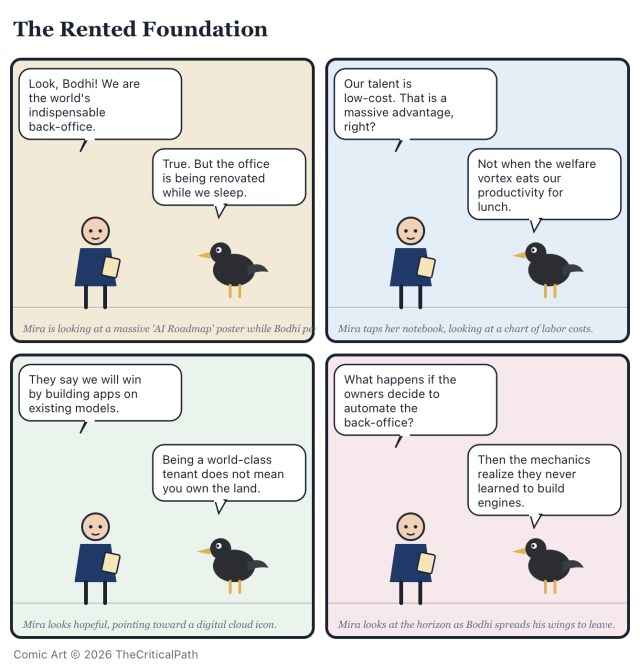
There are two dimensions to our current stagnation. First, India has failed to build the know-how and research to stay ahead in the race. Second, the money which should have been deployed in this endeavour is being sucked away by welfare schemes. In the global AI race, we are essentially playing on someone else's pitch. We have spent decades perfecting process optimization for foreign platforms, but we have failed to create foundational intellectual property. We are the world’s best mechanics, but we don't know how to design the engine.
While the US and China pour billions into foundational R&D, our focus is elsewhere. We spend less than 0.7 per cent of our GDP on research, and a huge portion of our national budget is tied up in subsidies. We are choosing consumption over creation. If AI capital stays in the US to build domestic infrastructure, as some analysts suggest following the midterm elections, India loses its window. We cannot be an "AI back-office" if the back-office itself is automated by tools we didn't build and don't own. Without foundational IP, we are just waiting for the day our current roles become obsolete.
The sugar-coated application pill
There is a popular argument that India doesn't need to build its own Large Language Models (LLMs) because we can "win at the application layer." To me, this is a sugar-coated diversionary pill. It is a way of making our indifference to foundational research sound like a strategy. We are being told to look at the apps and ignore the fact that the underlying technology belongs to someone else.
This indifference is dangerous. It is much like the "Viksit Bharat 2047" bogey, a promise of a developed state decades away that serves to distract us from the structural failures of the present. If we are content to just build applications on top of American or Chinese models, we are choosing to be rule-takers. We are building our digital future on rented land. A country that does not own its foundational technology cannot claim to be a global leader. It is just a very efficient tenant.
The danger of trusting national champions
Some argue that the only way out is the "National Champion" model, where the government puts its weight behind a few massive private conglomerates to lead the way. The logic is that the state lacks the teeth and the vision to push through real reforms, so we must rely on these giants to do the heavy lifting. But we have to ask if this is sane.
If these national champions are truly "National," that has to stand the test of time. Will they be generous like the Tatas were in the past? The Tatas built the Indian Institute of Science, Air India, and the Indian Postal System and then handed them over to the government for the welfare of the general public. Do the structures we are creating today have that kind of vision? I do not think so.
Handing over a strategic and visionary roadmap to private institutions is a massive gamble. We should remember what happened when the East India Company gained control of such strategic roadmaps. When private interest and national strategy become indistinguishable, the public good is rarely the priority. If our national champions are only interested in capturing the "vortex" for themselves, they are not champions of the country; they are just champions of their own balance sheets.
We are at a crossroads. We can continue to fund a welfare vortex and hope that our old stories about low-cost talent keep us safe, or we can start the hard work of building foundational know-how. If we keep choosing the sugar-coated pill, we shouldn't be surprised when we wake up to find the wall has been repainted, and we no longer recognise the farm.
Sources


