
When official systems offer only evasive talk and endless waiting, people eventually stop playing by the rules. You sit in quiet offices, listen to polished explanations that never quite answer your questions, and realise after months that you are no closer to a resolution than on day one. At first, you assume the delay is part of a necessary process. You assume the experts know what they are doing. But as the weeks drag on and the explanations become vaguer, the illusion wears off. At that point, formal channels cease to be of any real use. You have no choice but to drop the official representatives, step around the gatekeepers, and find your own informal shortcuts.
The Cult of Expert Evasion
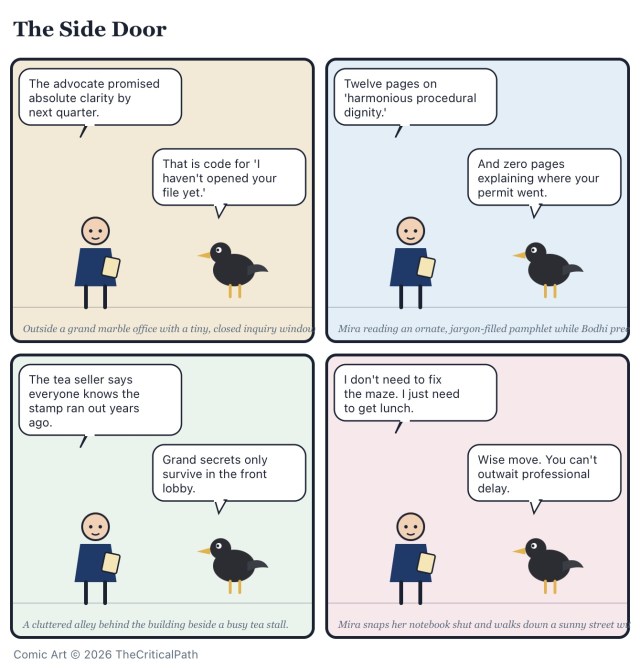
In Franz Kafka’s The Trial, Josef K. reaches his limit with his defence lawyer, Herr Huld. K. puts his trust in a high-status professional, only to discover that the man is lazy and unclear in his thoughts. Huld spends his time delivering long speeches about his own importance while submitting zero documents to the court.
I catch myself thinking about how often we tolerate this in modern institutions. We defer to self-appointed experts and administrative gatekeepers who hide behind grand reputations and formal authority. It makes you wonder why we spend so long listening to figures who preach process and policy while quietly delaying the things that matter.
The Open Secret and Withheld Truths
What makes an opaque system so frustrating is the gap between what is officially admitted and what everyone already knows on the street. In Kafka’s story, K. assumes his legal trouble is a private burden confined to himself and hidden court offices. Then a manufacturer walks into his bank office for a routine meeting and casually reveals that he knows all about the trial. The secret was never a secret. The formal system maintained a solemn silence, but the real information had already leaked through informal channels.
We see this pattern everywhere today. Official channels give us smooth explanations or hold back crucial numbers when they become inconvenient. A national jobs survey comes back with unhappy figures and gets mysteriously held back until the voting is done. The national census, meant to happen every ten years like clockwork, remains delayed. Whole chapters quietly vanish from school textbooks, removing centuries of history or basic scientific concepts like evolution, as if editing the wall will change what people remember. Meanwhile, complex political manoeuvres, like proposing a uniform fifty percent seat expansion across Parliament to implement a women’s quota while freezing regional relative shares until 2051, are framed as simple wins for federalism. The formal system acts as though everything is under control, but people outside the main halls know the real calculations long before the official announcements are polished.
Stepping into the Attic
When K. finally decides to bypass his lawyer, his search for practical answers leads him to Titorelli, the court painter. To get there, K. has to leave his comfortable bank office and climb up to a filthy, suffocating attic in an impoverished tenement, surrounded by rats, waste, and deafening noise from a nearby workshop.
Seeking the truth about how an opaque system operates rarely leads to a tidy place. If you want to understand how things are actually run, you cannot look at the public facade. You do not look at the world’s tallest statues, the new parliamentary buildings, or the grand sceptres carried by priests while basic infrastructure crumbles underneath. You have to look at the rough edges where decisions hit real life. The people who understand how the machinery functions are seldom sitting behind polished mahogany desks. They are living and working in the chaotic, unpolished spaces where the institution’s real work gets done without any public polish.
Keeping Life Moving
What strikes me most about K.’s journey is his motive. He does not go to the painter’s attic out of a desire to overthrow the legal system. He views the exhausting climb as a brief, tedious chore he must rush through so he can get back to his desk at the bank and salvage his workday.
That is how ordinary people navigate opacity today. They are not looking to start a revolution. They just want to stop inefficient, opaque systems from destroying their everyday lives. When the appointed advocates prove lazy and unclear, trusting them is just a form of passive defeat. Survival comes down to stepping around the gatekeepers, ignoring the grand rhetoric, and finding your own shortcuts to keep life moving forward.
Sources:
- Franz Kafka, The Trial
- Hindustan Times, “How Centre’s delimitation plan could change India’s electoral map: A look at state-wise numbers” (27 Nov 2026)


